
Animal Cell vs Plant Cell – A Complete Guide for Students
Understanding the difference between animal cells and plant cells is a fundamental topic in biology. Whether you are preparing for exams or building your basic concepts, this topic helps you understand how living organisms function.
In this guide, you will learn what an animal cell is, whether it has a cell wall, how plant cells are different, and how to easily understand diagrams.
If biology feels difficult, structured learning through platforms like Online Classes Network can make these concepts much easier and clearer.

What is an Animal Cell?
An animal cell is the basic structural and functional unit of animals. It is a eukaryotic cell, which means it contains a nucleus and several specialized organelles.
These cells perform essential life functions such as producing energy, removing waste, and supporting growth and reproduction.
Animal cells do not have a fixed shape. Their structure can vary depending on their function in the body.
Do Animal Cells Have a Cell Wall?
Animal cells do not have a cell wall. Instead, they have a cell membrane.
The cell membrane is flexible and controls what enters and leaves the cell. This flexibility allows animal cells to change shape, move, and form complex tissues.
Plants, on the other hand, require a rigid structure for support, which is why they have a cell wall.
Structure of an Animal Cell
An animal cell contains several important parts called organelles. Each organelle has a specific function.
The cell membrane forms the outer boundary and regulates movement of substances.
The nucleus controls the activities of the cell and contains genetic material.
The cytoplasm is a jelly-like substance where organelles are suspended.
Mitochondria produce energy for the cell.
Ribosomes are responsible for protein synthesis.
The endoplasmic reticulum helps in protein and lipid production.
The Golgi apparatus modifies and transports proteins.
Lysosomes break down waste materials.
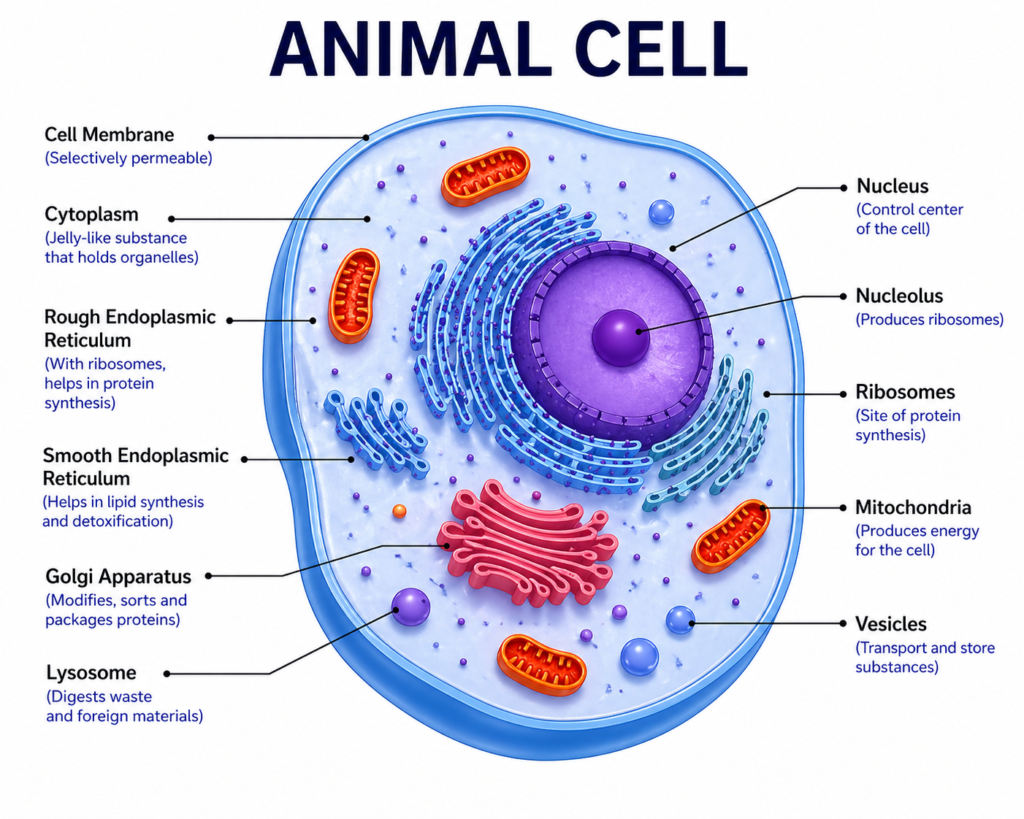
Animal Cell Diagram Explained
An animal cell diagram typically shows a round or irregular shape with a clearly visible nucleus in the center. Organelles such as mitochondria and ribosomes are spread throughout the cytoplasm.
One key feature to notice is the absence of a cell wall and chloroplast.
When studying diagrams, focus on identifying organelles and understanding their functions rather than memorizing shapes.
What is a Plant Cell?
A plant cell is also a eukaryotic cell but has additional structures that allow plants to produce their own food and maintain a fixed shape.
Plant cells are usually larger and more regular in shape, often appearing rectangular.
Structure of a Plant Cell
Plant cells contain all the components found in animal cells, along with some additional features.
The cell wall is a rigid outer layer that provides support and protection.
Chloroplasts contain chlorophyll and are responsible for photosynthesis.
A large central vacuole stores water and nutrients and helps maintain pressure inside the cell.
The cell membrane lies just inside the cell wall.
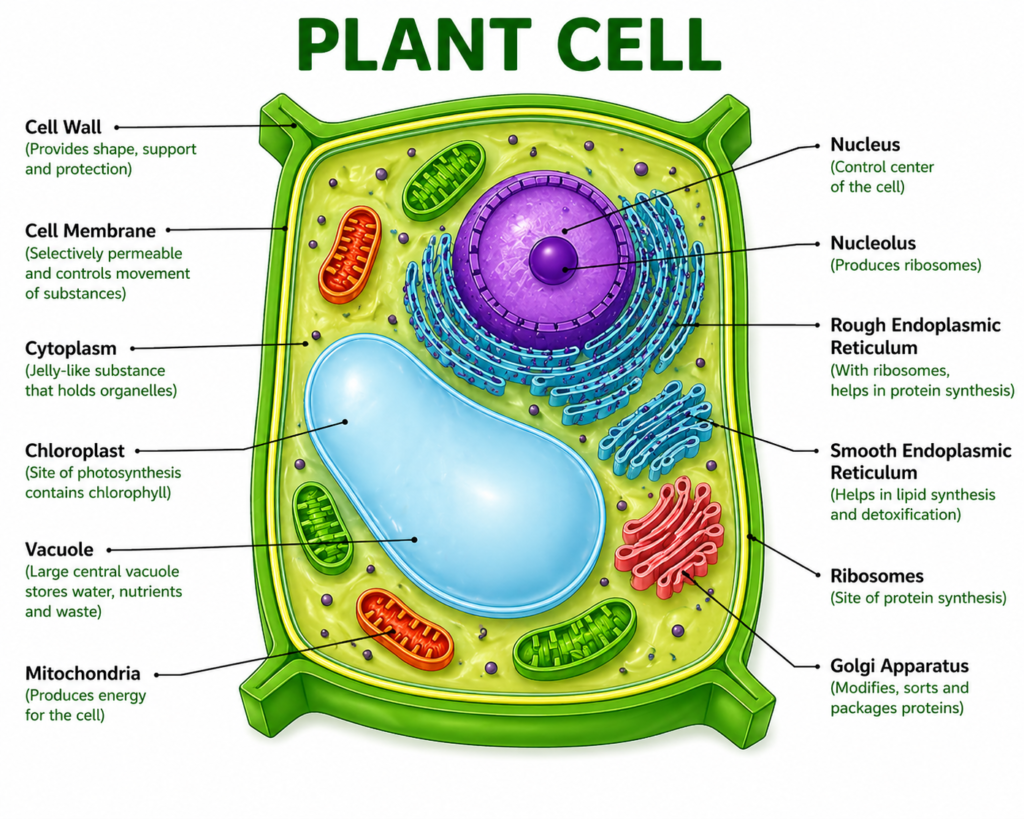
Difference Between Animal Cell and Plant Cell
Animal cells and plant cells differ in several important ways.
Animal cells do not have a cell wall, while plant cells do.
Animal cells are usually round or irregular in shape, whereas plant cells are more rectangular.
Chloroplasts are absent in animal cells but present in plant cells.
Plant cells contain a large central vacuole, while animal cells have smaller or no vacuoles.
Animal cells obtain energy from food, while plant cells produce their own food using sunlight.
Animal cells are flexible, while plant cells are more rigid.
Why is the Cell Wall Important in Plant Cells?
The cell wall plays a crucial role in plant cells. It provides strength and support, protects the cell, and helps the plant maintain its shape.
Without a cell wall, plants would not be able to stand upright or resist environmental pressure.
Why Don’t Animal Cells Have Chloroplasts?
Animal cells do not have chloroplasts because they do not perform photosynthesis. Instead, animals get energy by consuming food.
Plants use chloroplasts to convert sunlight into energy, which is why this structure is essential for them but not for animals.
Conclusion
Animal and plant cells are both essential for life, but they differ in structure and function.
Animal cells do not have a cell wall and are more flexible.
Plant cells have a cell wall, chloroplasts, and a large vacuole, which help them maintain structure and produce food.
A clear understanding of these differences makes learning biology easier and more interesting.